Bootcamps Curriculum Mentors Pricing Testimonials FAQ Corporate Contact Apply now Sign in
⚡ Cohort 02 starts in
--DAYS
:
--HRS
:
--MIN
:
--SEC
Thursday, July 17 · 7:30 PM ET · Cohort 02

Build real AI agents.
Engineer the future.

For developers who already use LLMs and want to build, evaluate, and deploy production-grade AI agents.

Claude API credits included
Claude Code access
Cloud workspace — no setup hassle
RAG Pipelines AI Agents Multi-Agent Systems MCP LangGraph LangSmith Guardrails Evaluation Deployment Demo Day Spec-based Development

COHORT 01 — DEMO DAY JULY 16

5 weeks. One deployed AI app — built on RAG, agents, multi-agent systems. Live demo day.
Drop your email — Reza will reach out personally.

No commitment. No spam.

Ready to apply? →

Information is free. Guidance, structure, and accountability are the new premium.

5wk
Intensive bootcamp
1 app
Built week by week
1:1
Expert feedback
What you'll build

You don't learn AI.
You build systems.

One project, built week by week — each layer graded and reviewed. Not notes. Not a certificate of watching.

WEEK 1 · FOUNDATION
Prompt-Powered
CLI Tool
  • Multi-step prompt chains
  • Structured JSON output
  • Context engineering
  • Written design rationale
WEEK 2 · ADD RAG
Production RAG
Layer
  • Ingest your own documents
  • ChromaDB vector store
  • Cited answers
  • RAGAS evaluation scores
WEEK 3 · ADD AGENTS
Autonomous Agent
& MCP Tools
  • RAG system wrapped as MCP tool
  • Agent reasons over your docs
  • LangSmith tracing
  • Failure diagnosis submitted
WEEK 4 · MULTI-AGENT + DEPLOY
Multi-Agent System
· Live URL
  • LangGraph supervisor routing
  • 10+ eval test cases
  • FastAPI + Railway deployment
  • Submit a live URL
WEEK 5 · MCP + DEMO DAY
MCP Deploy
& Demo Day
  • MCP server on Railway
  • Model fallback & error handling
  • Live capstone demo
  • Expert feedback + certificate
The problem

Most AI courses stop right
before reality begins.

01
They teach demos, not systems
You build a chatbot that works in a notebook. Then you try to deploy it and everything breaks.
02
They ignore evaluation entirely
No metrics. No tracing. No way to know if your agent is actually working or just confidently wrong.
03
They never show production failure
Real systems fail. Handling that gracefully — guardrails, fallbacks, observability — is never taught.
04
Deployment is an afterthought
Most courses end with "nice work." We end with a live URL, an eval report, and a Demo Day presentation.
If it's not deployed, evaluated, and observable — it doesn't count.
Your instructor

Built by someone who ships —
not just teaches.

Reza Ahmadi
Reza Ahmadi, Ph.D.
Principal AI Engineer · Professor, Queen's University
Builds and ships production AI systems in industry daily
Trained 200+ professionals across organizations on AI engineering
Professor at Queen's University School of Computing
Ph.D. in Computer Science
↗ LinkedIn Profile
Course syllabus

5 weeks. Real skills.
Shipped projects.

Thu 7:30–10 PM ET · Live 3–4 hrs/wk project work Graded project each week Evaluation in every assignment

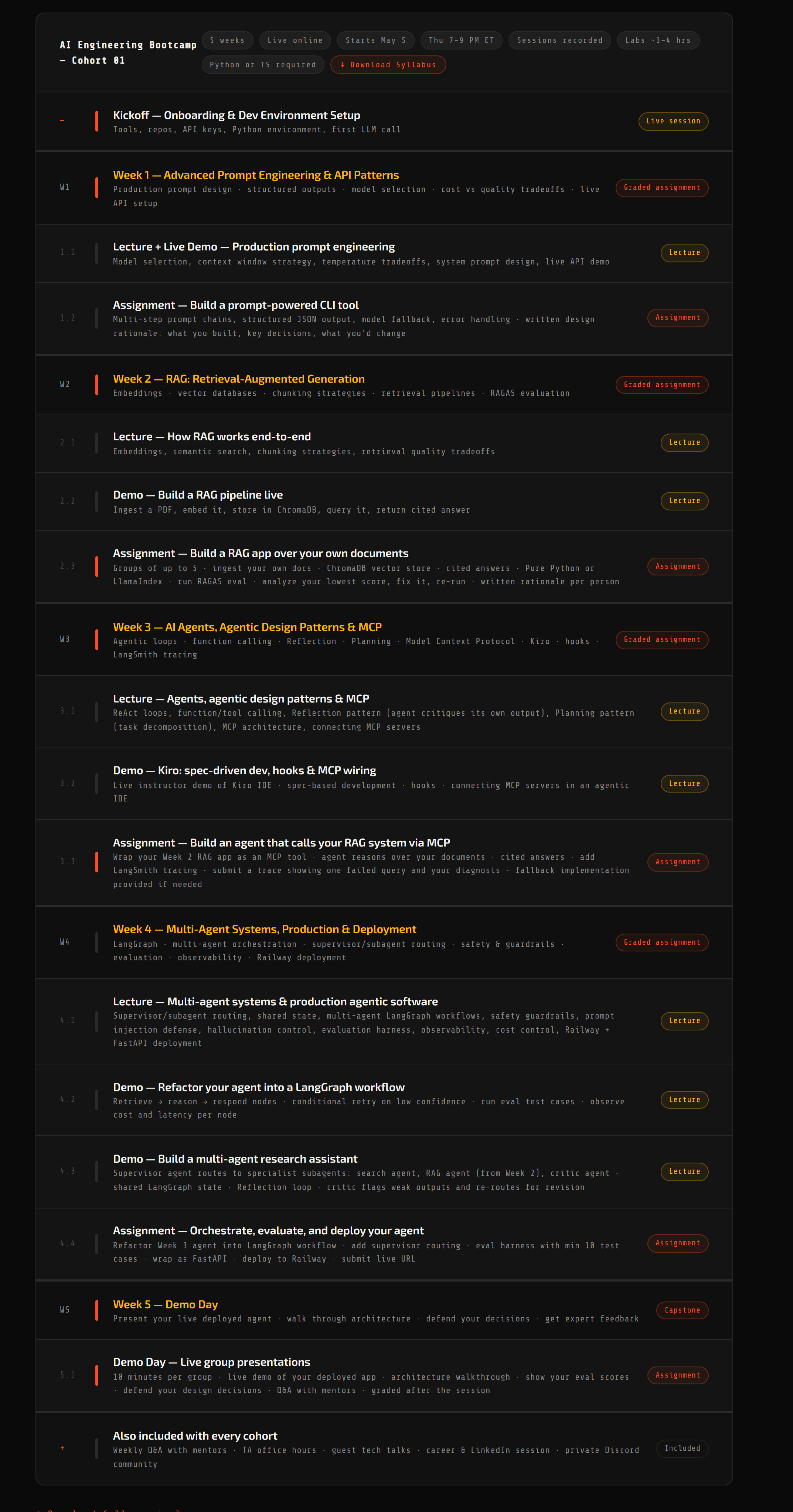
AI Engineering Bootcamp — Cohort 02

5 weeks Live online Demo Day July 16 Thu 7–9 PM ET Sessions recorded Projects ~3–4 hrs/wk Python or TS required ↓ Download Syllabus
Kickoff — Onboarding & Dev Environment Setup
Tools, repos, API keys, Python environment, first LLM call
Live session
W1
Week 1 — LLMs, Prompt Engineering & Spec-based Development
Tokens · context windows · system prompts · model families · spec-based development · structured outputs
1.1
Lecture — Prepare for the adventure
Set up your cloud IDE · verify API access · make your first model call · confirm your environment is ready for Week 1 onward
Lecture
1.2
Lecture — Prompt engineering and context engineering
Tokens, context windows, temperature, system prompts, model families (GPT-4o, Claude, Gemini)
Lecture
1.3
Lecture — Spec-based development: writing intent, not just prompts
A spec is requirements, behaviour, constraints — an evolution of prompt engineering. Live comparison: vague prompt vs. structured spec, same model, dramatically different output.
Lecture
1.4
Demos — Context engineering, tool-calling agent & spec-based dev
Context engineering in practice · small agent with mock tools calling independently · spec-based development workflow
Demo
1.5
🔬 Lab — Your first API call
Hands-on: make your first live model call, inspect the raw response, and handle the output in code.
🔬 Lab
1.6
Project — Build a prompt-powered CLI tool
Call the Anthropic and OpenAI APIs, chain prompts, handle structured JSON output, basic error handling. Submit your spec alongside the code.
Graded project
W2
Week 2 — Knowledge, Memory & Tool Systems for AI Agents
RAG · agent memory · MCP · tool design · reusable knowledge platform
2.1
Lecture — From LLMs to Agents
Agent architecture · tool calling fundamentals
Lecture
2.2
Lecture — Building RAG Systems
Embeddings, chunking, vector databases · chat-with-PDF
Lecture
2.3
Lecture — Memory for Agents
Short-term, long-term, episodic memory · memory stores
Lecture
2.4
Lecture — Agent Tool Design
Reusable tools · schemas · best practices
Lecture
2.5
Demos — RAG, Memory & Research Agent
Chat with PDFs · agent memory · research agent · Claude/Kiro consuming tools
Demo
2.6
🔬 Lab — Long-term memory and tools
Hands-on: give your agent long-term memory and wire up reusable tools it can call.
🔬 Lab
2.7
Project — Build a knowledge platform (RAG + Memory)
Foundation for the autonomous agents you build in Weeks 3–5
Graded project
W3
Week 3 — AI Agents & Agentic Design Patterns
ReAct loops · tool calling · agent memory · orchestrated vs. decentralized · spec-based development for agents
3.1
Lecture — Agents, tool calling & design patterns
ReAct agentic loops, function/tool calling. Orchestrated vs. decentralized architectures. Agent memory taxonomy. Claude as the reasoning engine.
Lecture
3.2
Lecture — Introduction to LangSmith and evaluation
LangSmith for tracing agent execution. Setting up evaluation datasets. Understanding agent behavior through observability. Introduction to evaluation metrics and testing strategies.
Lecture
3.3
Demo — Live ReAct agent with real tools
Build and run an agent live that reasons step by step, calls real tools, reflects on results, and loops until done. Watch the full reasoning trace in LangSmith.
Live demo
3.4
🔬 Lab — LangSmith with basic metrics
Hands-on: trace an agent run in LangSmith and measure it with a few basic evaluation metrics.
🔬 Lab
3.5
Project — Build an agent with real tools
Write a specification first, then wire an LLM agent to external tools. The spec is part of the graded submission — not just the code. Built with Claude + Kiro.
Graded project
W4
Week 4 — Multi-Agent Systems with Evaluation
LangSmith evaluation experiments · DeepEval + RAGAS metrics · LangGraph multi-agent orchestration
4.1
Lecture — Evaluation with LangSmith
Run evaluation experiments in LangSmith using golden datasets, comparing agent runs, analyzing traces, and identifying regressions and performance differences across versions.
Lecture
4.2
Lecture — Evaluation Frameworks (DeepEval + RAGAS)
Introduce evaluation frameworks (DeepEval + RAGAS) to systematically measure LLM and agent quality using metrics such as faithfulness, relevance, correctness, and retrieval grounding.
Lecture
4.3
Lecture — Multi-Agent Systems (LangGraph)
Design multi-agent systems using LangGraph, focusing on graph-based agent orchestration, task decomposition, and patterns such as sequential pipelines, hierarchical supervisor routing, and shared-state peer collaboration.
Lecture
4.4
🔬 Lab 1 — DeepEval metrics
Hands-on: score agent outputs with DeepEval metrics like faithfulness, relevance, and correctness.
🔬 Lab
4.5
🔬 Lab 2 — Multi-agent system test
Hands-on: build and test a small multi-agent system end to end.
🔬 Lab
4.6
Project — Multi-agent system with evaluation harness
Design and implement a multi-agent system using LangGraph. Run evaluation experiments with LangSmith to optimize agent performance. Assess output quality with DeepEval and RAGAS metrics. Document agent roles, task orchestration, and cost optimization strategies.
Graded project
W5
Week 5 — MCP, Deployment & Demo Day
Model Context Protocol · Deploy your multi-agent system to Railway · containerisation · model fallback & error handling · live presentations · architecture defense
5.1
Lecture — MCP: Standardizing Tools & Knowledge
Model Context Protocol (MCP) — standardized way for agents to call tools and access data across systems. MCP servers, tools, resources. Wrapping RAG and memory as MCP tools. Connecting agents to external systems.
Lecture
5.2
Lecture — Deploying your multi-agent system on Railway
Containerisation, Railway deployment, wrapping your LangGraph agent as a FastAPI service, structured logging, cost monitoring, production readiness checklist.
Lecture
5.3
🔬 Lab — Sample MCP deploy on Railway
Hands-on: deploy a sample MCP server to Railway and connect an agent to it.
🔬 Lab
5.4
Capstone Demo Day — Live presentation to the mentors
Present your deployed capstone project live. Walk through architecture decisions, defend tradeoffs, receive detailed expert feedback. Certificate awarded on completion.
Capstone
5.5
Demo Day — Second round of presentations
Second day of capstone presentations for the cohort. Live demos, Q&A, and peer feedback.
Demo Day
+
Also included with every cohort
Weekly Q&A with mentors · async discussion with instructor · 1-on-1 sessions on demand · guest tech talks · Anthropic API credits · all sessions recorded · completion certificate · Credly digital badge for LinkedIn
Included
↓ Download full curriculum
COHORT 01 · DEMO DAY JULY 16, 2026
You've seen the curriculum. Ready to build?
How it works

From API calls to production —
in 5 weeks.

No intro content. No passive watching. You build production-grade systems, ship them, and get reviewed by working engineers.

01

Register & join your cohort

Apply, get accepted, and join a cohort of serious AI builders.

02

Learn through live sessions

Weekly live classes taught by your instructor — a working AI engineer and CS professor.

03

Deliver real projects

Each module ends with a graded project. Build RAG apps, agents, and full pipelines.

04

Get expert feedback

Detailed code review and written feedback on every submission. No auto-graders.

Why AiBricks

Built for engineers,
not beginners.

Every decision made for developers who already know how to code and want to build real AI systems — not watch intro videos.

Cohort-based learning

You learn with a group, not alone. Accountability, peer reviews, and shared momentum built in.

Graded projects, real feedback

Every project is marked by an expert — not an LLM. Expect detailed, honest critique.

Taught by a practitioner

Your instructor is a CS professor and industry AI engineer. Theory meets real production experience.

No fluff, no filler

Deliberately short curriculum. Only what matters. Every hour spent is an hour that compounds.

Small cohorts only

Max 100 students per cohort. Real access to the instructor, not just a Slack channel.

Private Discord community

Cohort-only Discord server — ask questions, share progress, and get help between sessions. Active 24/7.

Anthropic API credits included

API credits provided for all coursework — no out-of-pocket API costs. Additional usage beyond assignments at student's expense.

Portfolio on graduation

Leave with 1 production app — RAG, agents, multi-agent orchestration, deployed — built week by week, ready to show employers.

Your instructors

Learn from people
who ship in production.

Not content creators. Working AI engineers with real industry experience. Each cohort also includes guest talks from leading figures in AI engineering and agentic AI.

Dr. Reza Ahmadi
Reza Ahmadi, PhD
Principal AI Engineer · Professor, Queen's University

With 15+ years of industry experience, Reza works at the intersection of industry and academia — building production AI systems by day, teaching software engineering at Queen's. He has trained 200+ professionals in AI engineering.

LLMs & Agents Production AI MLOps ↗ LinkedIn
Sami Riaz
Sami Riaz
AI Engineer in Industry · McGill University Alumni

Sami brings 7 years of professional software engineering experience to AiBricks. Currently working as an AI engineer in industry with a strong foundation from McGill University.

AI Engineering Software Engineering 7 Years Industry ↗ LinkedIn
?
Guest Speakers
Leading figures in AI engineering & agentic AI

Each cohort includes exclusive guest talks from practitioners at the frontier of AI engineering. Names to be announced.

Pricing

One cohort. Two options.
Zero fluff.

Cohort 01 is priced to get serious people in the room. Price increases for Cohort 02.

COHORT 01 PRICE
Early access
$1,200 USD
one-time · limited seats · all sessions recorded
Regular price $1,997 USD
  • Build 1 real app — layering RAG, agents, multi-agent orchestration, and deployment week by week
  • Get expert written feedback every week as you build
  • Walk away with a deployed, production-grade AI app you can demo to employers
  • Live sessions with Q&A — every session recorded and shared within 24hrs
  • Anthropic API credits included — no extra cost for coursework
  • Private cohort community — peers building the same things in real time
  • Verified completion certificate + Credly badge for your LinkedIn
Not satisfied after Week 1? Email us within 7 days for a full refund — no questions asked.
Payment plan
$400
USD × 3 months
$1,200 USD total · split over 3 months
Same full access. First payment due at enrollment. Remaining two payments billed biweekly. All payments complete before certifications are issued. No hidden fees.
  • Everything in the full plan
  • Split into 3 monthly payments
  • No interest, no penalty
Cohort 01 · Regular price $1,997 USD from Cohort 02 onwards
TEAMS & ORGANIZATIONS
Training your whole engineering team?
Custom cohorts available for companies. Same curriculum, delivered privately for your team — on your schedule.
Get in touch →
What people say

What people say.

Anonymous feedback from Queen's University students, and direct feedback from industry professionals after sessions with Reza.

"Even I was able to run the AI analysis today — and I'm not technical at all. I love it! Thanks Reza for the knowledge transfer."

— Rena · Engineer

"I'm finding the tool we made during the session more useful than Kiro for initial investigations right now. Hats off Reza for however you did that. I'd love to get a deeper understanding of how it works."

— James · Engineer

"Obviously cares a lot about the course. Quick to respond to questions. Assignments are well-written and unambiguous. The course is not very stressful."

— Software Engineering Student at Queen's University

"Great instructor — cares very much about the content. Well organized. Interesting material."

— Software Engineering Student at Queen's University

"Super helpful content, presented in a clear manner."

— Software Engineering Student at Queen's University

For companies

We provision your workspace.
We train your team.

Two ways to work with us — or both. Either way, you leave with something real.

OPTION 1
WORKSPACE: Cloud Environment

Cloud-based development environment preconfigured with Python, Claude, LangChain, LangSmith, and cloud integrations. Accelerate onboarding, deliver hands-on training, or provide consistent engineering environments—ready in minutes, not days.

  • No setup hassle
  • Everything preconfigured
  • Deploy in a couple of clicks
OPTION 2
TRAIN: Corporate Training

Your team learns by building a real agent for your own process or product — hands-on, on your stack. They leave capable of building and maintaining agents independently.

"Even I was able to run the AI analysis today — and I'm not technical at all."

— Rena · Engineer
Ready to talk?
Reza responds personally. No sales team, no pitch deck.
Get in touch →
FAQ

Common questions.

Who is this for?
This is an advanced bootcamp for developers who have already used LLMs — called an API, built a toy project, or experimented with ChatGPT. You write Python or TypeScript daily and you're ready to go beyond tutorials and build systems that work in production. If you've never written code before, this is not the right course. Time commitment: 2.5 hrs live Thursdays 7:30–10 PM ET plus 3–4 hrs self-paced project work per week. All sessions recorded.
What if I'm not satisfied?
Full refund if you email us within 7 days of the Week 1 session. No forms, no explanations required. We've made this easy on purpose — we want serious learners, not reluctant ones.
What if I miss a live session?
Every session is recorded and shared with the cohort within 24 hours. You won't fall behind. Projects are self-paced and due before the next session.
Do I need a machine learning background?
No. This is an AI Engineering bootcamp — you'll learn to build systems that use AI, not train models. Python or TypeScript basics are all you need to start.
How does the payment plan work?
First payment ($400 USD) is due at enrollment and gives you immediate full access. Payments 2 and 3 are billed automatically biweekly via Stripe, so all payments are complete by the end of the bootcamp and before certifications are issued. All 3 payments are committed at enrollment — this is a structured plan, not a subscription you can cancel.
Do I get a certificate?
Yes. Students who complete all projects receive an AiBricks AI Engineering certificate. Cohort 01 graduates will also receive a Credly digital badge suitable for LinkedIn.
Is payment handled securely?
Yes. All payments are processed via Stripe — we never see or store your card details. You'll receive a Stripe receipt immediately after payment.
Can I show my projects to employers?
Yes — that's the point. After the cohort ends, your project repos become yours to make public. Your Week 4 capstone is a live deployed app with a real URL, LangSmith traces, and an eval report. You can link it directly on your resume and LinkedIn as a production-grade AI engineering project.
What is Demo Day exactly?
Demo Day is Week 5 — you present your Week 4 capstone project live to the cohort. You show the running app at its live URL, walk through the architecture, show your LangSmith traces, and defend your design decisions. It's 10 minutes per student with Q&A. This is your capstone — not a separate project, but your best work fully polished and deployed.

Ready to build seriously?

Cohort 02 is forming now. Drop your email to get notified.

Apply Agent